
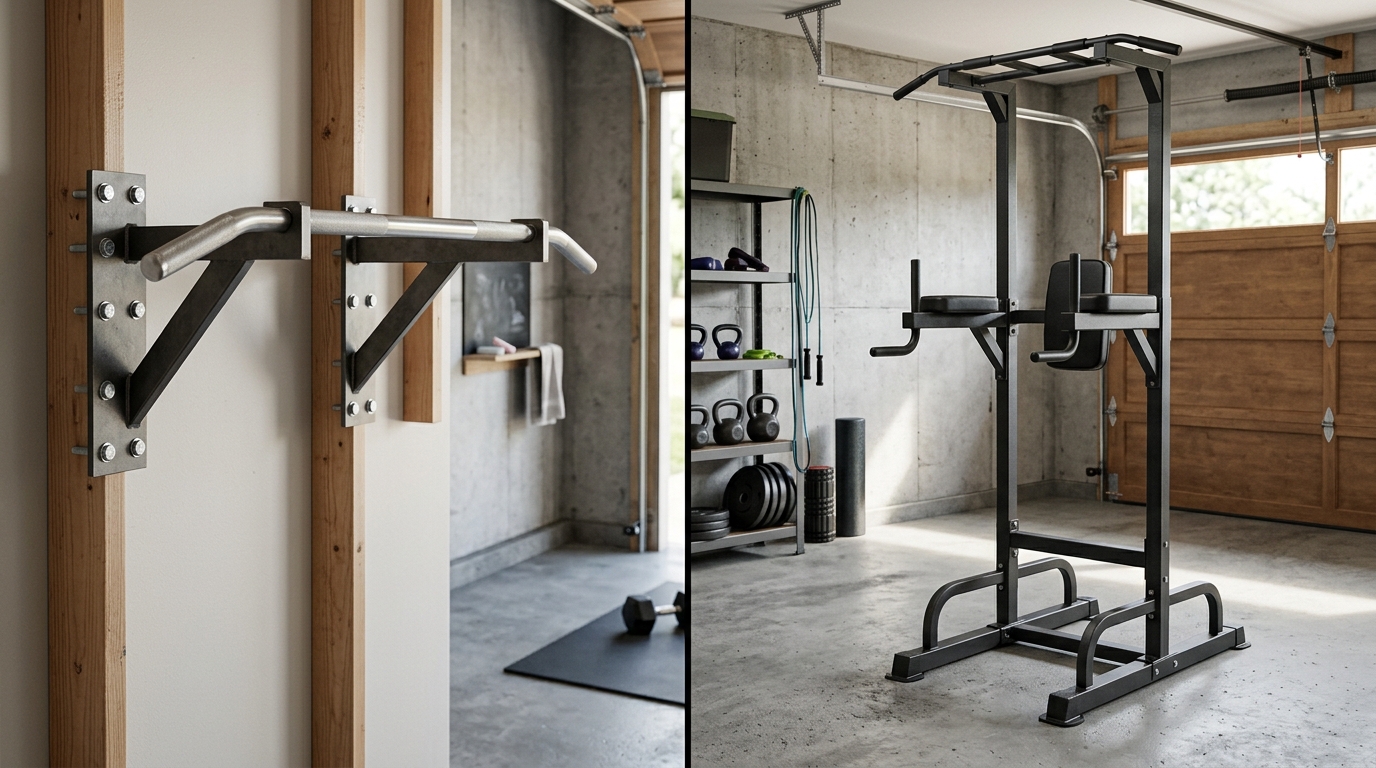
Picking between a wall-mounted vs freestanding pull-up rig usually comes down to one practical question: do you own the wall you’d be drilling into? Everything else follows from that answer: stability, cost, and how much floor space you’re willing to give up.
Both categories will get you through a full pull-up session without embarrassing themselves. The real differences show up over months, not on day one; that’s when bolts either stay tight or don’t, and a tower either holds its spot or migrates two inches across the garage floor during a hard set of kipping pull-ups.
In This Comparison
- Stability Under Load
- Installation and Permanence
- Space and Portability
- Cost Comparison
- Weight Capacity and Grip Options
- Wall-Mounted vs Freestanding: Which One Should You Buy?
- Frequently Asked Questions
Stability Under Load
A wall-mounted bar transfers force straight into the building structure. Bolt it into 16-inch on-center studs (the standard spacing in most North American homes) and the wall itself becomes part of the rig. There’s nothing to tip, shift, or walk across the floor, no matter how hard you kip.
Freestanding rigs work differently. They resist tipping through base width and frame mass instead of an anchor point. A narrow, light tower will rock during dynamic movement; a wide one won’t, or at least not enough to notice. The Sportsroyals Power Tower, for example, uses a 39.7-inch H-type base and a 62-lb frame, and it stays planted for strict pull-ups and controlled sets. Push it into aggressive kipping past 200 lbs bodyweight, and you’ll feel the frame shift slightly. Not dangerous, just noticeable.
Kipping generates roughly 1.5x your bodyweight in downward force at the top of the swing. That number matters more than most buyers realize. If you kip regularly or train with a weighted vest, a wall mount removes stability from the list of things you have to think about.
Installation and Permanence
Wall mounting is a real project, not a weekend afterthought. You’ll need to locate studs (a stud finder earns its keep here), confirm spacing matches the bar’s mounting pattern, and drive lag bolts into solid wood rather than drywall alone. Budget 60 to 90 minutes if you’ve done this before, longer if you haven’t, and plan for a second pair of hands to hold the bar level while you mark bolt holes.
Get it wrong and you’re patching drywall, not returning a product. That’s the real cost of a bad wall-mount decision: it’s not the bar, it’s the hole.
A freestanding rig skips all of that. Unbox it, assemble it (30 to 50 minutes depending on the model), and you’re training within the hour. No studs, no anchors, no landlord conversation. If you’re renting, that alone can decide the question for you.
Space and Portability
Wall-mounted bars project 14 to 22 inches off the wall, depending on the model, and use zero floor space beyond that. In a small home gym or a garage shared with a car, that difference is significant. You get the bar back the moment you’re done; nothing to fold, roll away, or trip over.
Freestanding towers need a dedicated footprint, typically around 48 by 52 inches for a standard power tower, plus clearance to move around it. Some fold flat for storage; most don’t. What you gain is portability. Move apartments, rearrange the garage, or sell it later, and it goes with you. A drilled bar stays with the wall.
Cost Comparison
Entry-level freestanding towers start lower, often in the $80 to $130 range for compact models. Full-size power towers with dip bars and knee raise stations run $150 to $250. Budget wall-mounted bars start around $100 to $180; heavy-duty, high-capacity versions (700-lb rated, multi-grip) run $200 to $300.
At the low end, freestanding wins on price. At the high end, the gap narrows enough that cost stops being the deciding factor and durability takes over.
Weight Capacity and Grip Options
Capacity is one more place the wall-mounted vs freestanding pull-up rig gap shows up clearly. Wall-mounted bars generally carry higher static ratings because the load path runs through the wall instead of a floor-standing frame. A mid-range wall bar rated to 400 lbs and a premium 11-gauge model rated to 700 lbs are both common; either one leaves plenty of margin for weighted pull-ups. Multi-grip wall bars also tend to offer more hand positions (wide, neutral, close, angled) in a single fixed bar than most towers do.
Freestanding towers cap out lower, usually 250 to 480 lbs static depending on frame weight and base width. That’s still well above most home users’ training weight; it just leaves a smaller margin once you add a vest or start kipping hard.
Wall-Mounted vs Freestanding Pull-Up Rig: Which One Should You Buy?
The wall-mounted vs freestanding pull-up rig decision gets easier once you separate what you control from what you’d prefer. Renters, apartment dwellers, and anyone unsure about their next move should default to freestanding; no installation means no risk. Homeowners who train hard, kip regularly, or plan to stay put for years get more long-term value from a wall mount, even with the extra setup effort.
If a wall mount fits your situation, the REP Fitness Multi-Grip is the pick we’d point most home gym builders toward: 700-lb rated, five grip positions, and mounting hardware that works with standard 16-inch stud spacing.

- WALL MOUNTED REQUIREMENTS: Concrete brick/solid cement wall/solid red brick wall /solid tile wall are a great surface for mounting this pull up bar and dip station. DON'T install on hollow brick wall/honeycomb brick wall/drywall /sandwich panel. Full instructions & all mounting hardware are included.
- VERY WELL-BUILT and SOLID STRUCTURE: Made of high-grade steel with black matte powder coating, six mounting holes on each stand, offers great stability and rigidity and supports up to 330 pounds.
- DETACHABLE and ERGONOMICALLY DESIGN: Package comes with a wall mounted pull up bar and a dip tower-can be disassembled easily when you are boxing-save space and money with all-in-one equipment.
- VERSATILITY: This model has various handles which allow you to perform wide, hammer, or close-grip exercises that can reach many different muscle groups.Allows you to engage in a huge variety of workouts like sit-ups, push-ups, dips, leg raises, boxing, and resistance training.
- COMFORTABLE,DURABLE CUSHION AND GRIPS: Range of gripping positions, including neutral grip. The pull up bar is 38 inches long to allow for extra wide grip pull ups and chin ups. Nonslip handles provide comfort when you are exercising. Tear resistant, Well-padded, high-density, padded back and arm cushions provide comfort as you work out your abdomen, waist, chest, and upper limbs.
Leaning freestanding instead? The Sportsroyals Power Tower covers pull-ups, dips, and knee raises in one footprint for under $220, and its 39.7-inch H-base holds up well for controlled training.

If you’re strictly doing controlled strict pull-ups with no kipping and no added weight, either option holds up fine. Let your living situation decide, not the spec sheet.
Frequently Asked Questions
Is a wall-mounted or freestanding pull-up rig safer?
Properly installed, a wall-mounted bar is more stable because it anchors into the building structure rather than resisting tip-over through weight alone. A freestanding rig is just as safe within its rated capacity, but a narrow or lightweight model can shift under aggressive kipping.
Can I switch from freestanding to wall-mounted later?
Yes. Plenty of people start with a freestanding tower while renting, then install a wall-mounted bar once they own a home or commit to a permanent training space. The two aren’t mutually exclusive if you have room for both.
Do freestanding rigs work for kipping pull-ups?
Heavier, wider-base models handle moderate kipping reasonably well. Compact or budget towers under 300 lbs static capacity generally aren’t built for it; stick to strict pull-ups on those.
Where to Start
Still weighing a wall-mounted vs freestanding pull-up rig for your specific space? The wall-mounted pull-up bar guide ranks the top options by stability and clearance, and the freestanding pull-up rig guide covers the best portable towers by price and capacity. For the full picture across every rig type and budget, the best pull-up rigs for home gyms guide is the place to start.