
The pull-up bar vs pull-up rig question trips people up mostly because retailers use the two terms loosely, and sometimes interchangeably, when they actually describe different categories of equipment. Get the terms straight first and picking the right product gets a lot easier.
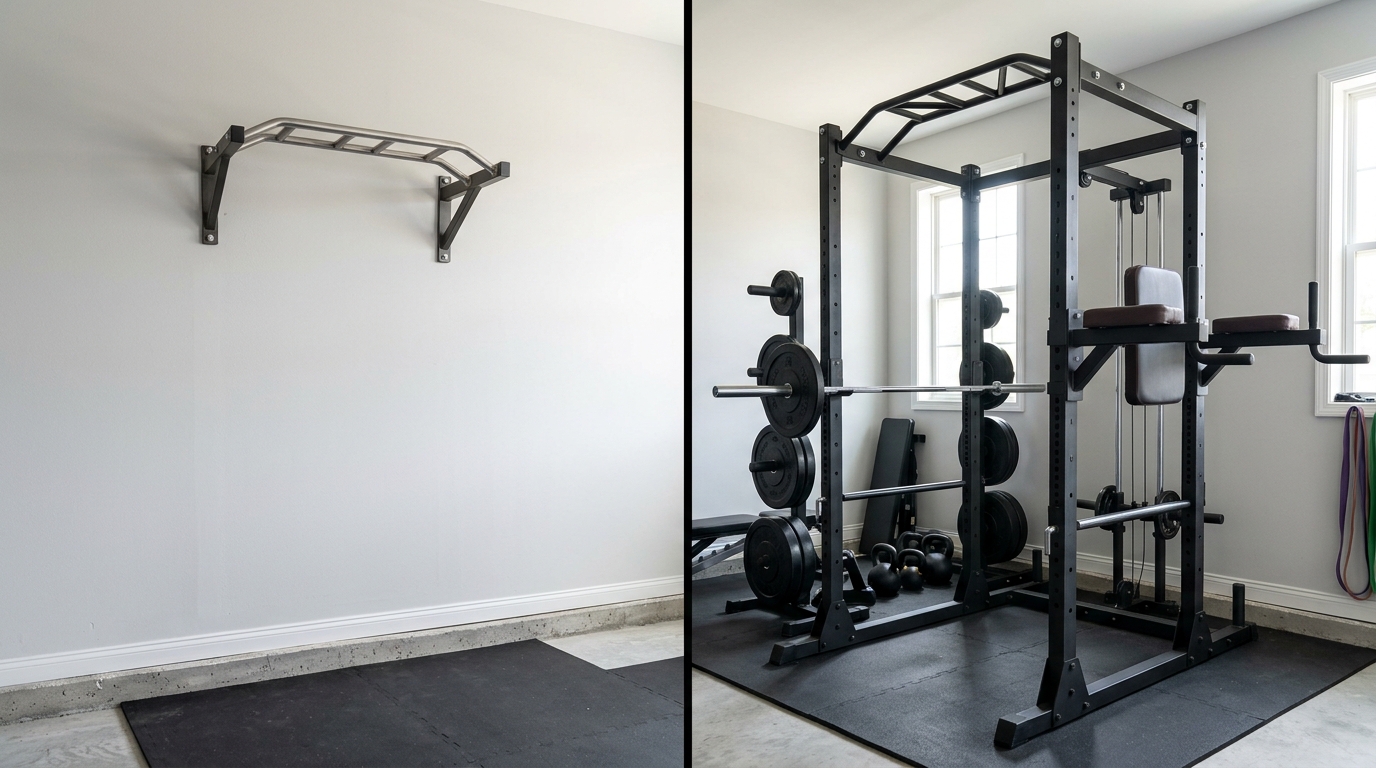
Short version: a bar is one fixed piece for hanging and pulling. A rig is a bigger structure built around a bar, usually with room for other movements too. Neither side of the pull-up bar vs pull-up rig split is inherently better; they solve different problems.
In This Guide
- What Counts as a “Bar”
- What Counts as a “Rig”
- Build and Capacity Differences
- Price Differences
- Pull-Up Bar vs Pull-Up Rig: Which Do You Need?
- Frequently Asked Questions
What Counts as a “Bar”
A pull-up bar is a single fixed bar, mounted to a wall, a doorframe, or a ceiling joist. That’s it. No dip station, no knee raise pad, no additional attachments beyond maybe a couple of grip positions. Its whole job is one movement pattern: hanging and pulling.
Doorframe bars sit at the cheap, temporary end of this category; they wedge into a door casing with no drilling and come down in seconds. Wall-mounted and ceiling-mounted bars sit at the permanent end, bolted into studs or joists and rated for real weight. Either way, a bar stays a bar: one movement, one footprint, nothing extra bolted on.
What Counts as a “Rig”
A pull-up rig is built around a bar but adds structure: dip handles, a knee raise station, sometimes a full cage frame with band pegs and a barbell setup. Power towers are the entry point here. Full garage rigs and cages sit at the top, rated for hundreds of pounds more than a wall bar and built to expand as your training does.
The word “rig” gets used loosely in calisthenics and CrossFit circles to mean almost any multi-station structure, which is part of why the terminology gets confusing. For this guide, a rig is anything that gives you more than a single hanging bar in one footprint.
Build and Capacity Differences
A quality wall-mounted bar is rated 400 to 700 lbs and made from 11-gauge steel; that’s plenty for weighted pull-ups and most kipping work. A budget doorframe bar rarely clears 300 lbs and isn’t built for anything dynamic.
Rigs vary more widely because the category is so broad. A compact power tower might cap out around 250 to 300 lbs static. A full cage-style rig, anchored at four points with 2×2-inch steel throughout, can be rated 1,500 lbs or more. The trade-off is footprint and installation effort scale up right alongside the capacity.
Price Differences
Bars are cheap at the low end. A basic doorframe bar runs $25 to $40. A solid wall-mounted bar with multiple grip positions lands around $100 to $180, with premium 700-lb models topping out near $300.
Rigs start higher and climb fast. Compact freestanding towers begin around $80 to $130. Full-size towers with dip and knee raise stations run $150 to $250. Cage-style garage rigs with a lat pulldown or cable system start around $400 and go well past $1,000 for commercial-grade setups.
Pull-Up Bar vs Pull-Up Rig: Which Do You Need?
If pull-ups (and maybe hanging leg raises) are the only movement you care about, a bar covers it, costs less, and takes up almost no space. The REP Fitness Multi-Grip wall bar below is a solid example: five grip positions, 700-lb rating, and a footprint of basically nothing once it’s mounted.

- WALL MOUNTED REQUIREMENTS: Concrete brick/solid cement wall/solid red brick wall /solid tile wall are a great surface for mounting this pull up bar and dip station. DON'T install on hollow brick wall/honeycomb brick wall/drywall /sandwich panel. Full instructions & all mounting hardware are included.
- VERY WELL-BUILT and SOLID STRUCTURE: Made of high-grade steel with black matte powder coating, six mounting holes on each stand, offers great stability and rigidity and supports up to 330 pounds.
- DETACHABLE and ERGONOMICALLY DESIGN: Package comes with a wall mounted pull up bar and a dip tower-can be disassembled easily when you are boxing-save space and money with all-in-one equipment.
- VERSATILITY: This model has various handles which allow you to perform wide, hammer, or close-grip exercises that can reach many different muscle groups.Allows you to engage in a huge variety of workouts like sit-ups, push-ups, dips, leg raises, boxing, and resistance training.
- COMFORTABLE,DURABLE CUSHION AND GRIPS: Range of gripping positions, including neutral grip. The pull up bar is 38 inches long to allow for extra wide grip pull ups and chin ups. Nonslip handles provide comfort when you are exercising. Tear resistant, Well-padded, high-density, padded back and arm cushions provide comfort as you work out your abdomen, waist, chest, and upper limbs.
If you also want dips, knee raises, or room to add a barbell setup later, a rig is the better long-term buy, even though it costs more upfront. The Mikolo Power Cage is a real rig in the fullest sense: 1,500-lb rated, expandable, and built to be the anchor piece of a garage gym rather than one station in it.

Budget and space are the other two variables in the pull-up bar vs pull-up rig decision. A bar wins on both. A rig wins on training variety and long-term headroom. Pick based on what you’ll actually use in six months, not what looks most complete in the box.
Frequently Asked Questions
Is a power tower a bar or a rig?
A power tower is a rig, just a small one. It adds dip bars and a knee raise station around the pull-up bar, which puts it past the single-movement definition and lands it on the “rig” side of the pull-up bar vs pull-up rig line, even though it’s freestanding and compact compared to a full cage.
Can I upgrade from a bar to a rig later?
Yes, and plenty of people do exactly that. Start with a wall-mounted or doorframe bar, then add a rig once you know you’ll keep training and have the space and budget for it. The bar doesn’t go to waste; it just becomes a second pull-up station.
Do rigs always need to be bolted down?
No. Freestanding towers and compact rigs rely on base width and frame weight instead of anchoring. Full cage-style rigs are usually bolted to the floor for safety once you’re loading a barbell on them, but a power tower is designed to stand on its own.
Where to Start
Leaning toward a bar? The wall-mounted pull-up bar guide ranks the top options, and if permanent installation isn’t an option, the freestanding pull-up rig guide covers portable alternatives. Already decided you need a full rig? The garage gym rig guide is the next stop. And if you’re still weighing wall-mounted against freestanding specifically, our wall-mounted vs freestanding comparison covers that decision in detail.